myparkingsign.com

Call Now
Mon-Thu 8am - 7pm
Fri 8am - 6pm EST
Free Shipping
for orders of
$25.00 and more
Shopping Cart
 • $25.00 until free shipping.
Home  |  Custom Signs  |  No Parking Signs  |  Handicap  |  Reserved Parking  |  Parking Lot  |  Tow Away  |  Permit Parking  |  Designer  |  Posts

Learn About Safe Routes to School

Hayden looks back at his younger years when walking and biking with friends to school was a leisure activity. He viewed it as a way of becoming ‘one’ with nature. Biking kept him fit and walking relaxed him. Now 30 years later, when he drives his son to school, he realizes how time has changed.

Walking and biking to school is a trend that has vanished with time. Children walking or biking to school was a common sight thirty years ago. Nearly ninety percent of children who lived close to their schools (within a mile) used an active means of transportation (i.e. biking and walking) then.

But this rate has rapidly declined in recent years. Only 10% of children across the country walk to school now and only 25% of the children whose schools are located at a distance of less than a mile are regular walkers.
Some of reasons for this decline are cited below-

1. Traffic congestion- Increased traffic congestion and the fear of little children falling victim of vehicular traffic crashes are the reasons why concerned parents do not allow their children to use active means of transportation to school.
2. Crime against children- In a report compiled by CDC, 11.7% of parents cited crime as a barrier to active transportation.
3. Adverse weather conditions- According to the CDC report, 18.6% of parents consider adverse weather as a sticking point. There have been slight changes in the weather over the past 30 years but the pattern of these changes is not distinct.
4. Distance- Distances to school have increased over time as the number of schools decreased by nearly 1000 and the number of students went up by 2 million (According to NCES 2003). This means schools are now located further from home.
The consequences of the above barriers hinder the use of active transportation among children. Moreover, it decreases their level of physical fitness. This further gives way to childhood obesity. It is reported that close to 12.5 million (17%) of children between 2-19 years are obese and lack of physical activity is one of the prime reasons for it.

Walking and biking to and from school is the best and the most inexpensive way to get some exercise. It is also the most effective way to reduce traffic congestion and improve the air quality.

‘Safe Routes to School’ (SRTS), an initiative of the Federal Highway Administration, addresses the abovementioned issues and focuses on empowering communities to make bicycling and walking to school a routine activity.SRTS combines different approaches to create a safe environment for children to encourage them to walk and bicycle to school. In this way, it aims at increasing the number of children using active transportation to school.
The different approaches are-

1. Engineering- creating safer environments for walking and bicycling to school by improving infrastructure around schools. This includes lowering motor vehicle speeds and setting up safer and accessible walkways, crossings and bikeways.

2. Education-teaching little children how to walk and bicycle safely; informing drivers on how to drive more safely around bicyclists and pedestrians; involving children, parents, caregivers and neighbors in this strategy.

3. Enforcement- increasing safety of children walking and bicycling to school by assisting to change rash behaviors of drivers, bicyclists, and pedestrians. This strategy looks for involvement of parents, students, school, crossing guards and law enforcement officers.

4. Encouragement- promoting activities like walking and bicycling by organizing events such as Walk to School Day and holding contests such as Frequent Walker/Bicyclist Challenge etc.
5. Evaluation- collecting information before and after implementation of projects and activities, thus allowing communities to track outcomes and progress. This strategy will also provide information to guide program development.
Signs help make the Walk or Bike Ride Safer

Signage is the most effective way to safeguard kids on roads. Safety of children is especially required when children go and come back walking or bicycling from school.

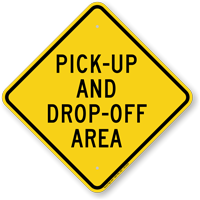
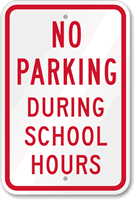
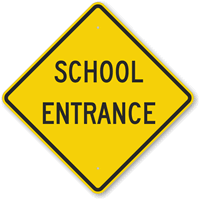
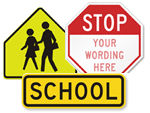
Pedestrian Signs and School Signs make it safer for children to move around on foot and bikes. Moreover, signs help the drivers gauge the speed limit and take the necessary precautions while moving around a school area.Green color in retro reflective signs draws a motorist’s attention faster. The MUTCD permits use of the retro-reflective yellow-green color for non-motor vehicle warnings.

A number of communities are opting for these high-visibility signs for school zones to make school crossings prominent and noticeable. SRTS guide states that if retro-reflective yellow-green signs are used, this color should be used consistently throughout the school zone and not mixed with standard yellow school warning signs.

Smartsign BBB Business Review
Order online 24 hours a day
using secure Google and
PayPal checkout. Pay by:
Pay by MasterCard, Visa, AmEx, Discover
Verified by PayPal
The safer, easier way to pay.
This site is tested daily and
certified Hacker-Safe site by:
McAfee Secure sites help keep you safe from identity theft, credit card fraud, spyware, spam, viruses and online scams