
What to Know About Parking Sign Reflectivity
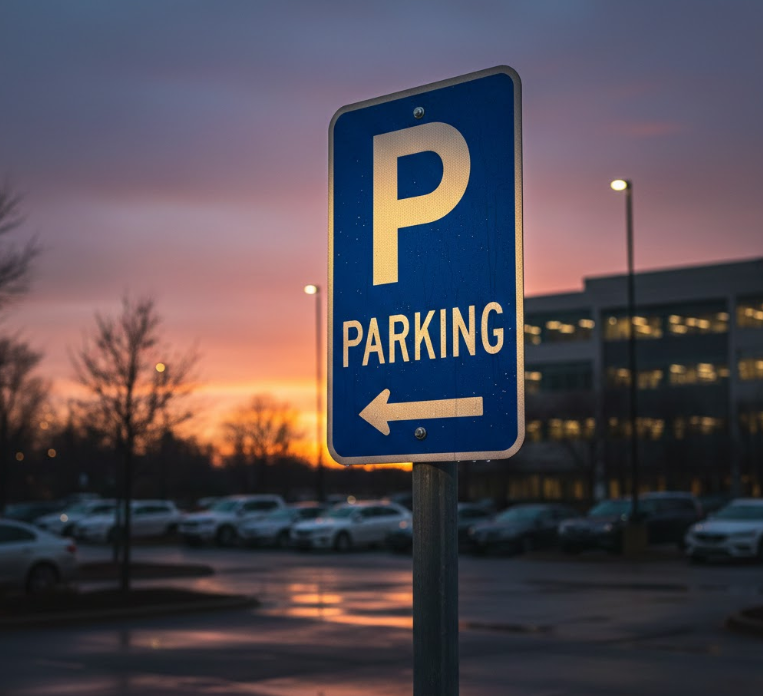
As a property manager, few things are more stressful than a parking lot accident. You have done your best to maintain the pavement and paint the lines. But when a driver pulls into your lot at night, rain lashing against the windshield, can they actually see your signs?
If your Stop signs or Do Not Enter markers are faded or non-reflective, they become invisible to drivers in the dark. This creates a dangerous liability gap. If a vehicle is towed and the owner claims the Tow-Away Zone sign was not visible at 9 PM, you are often the one responsible for the fees.
The solution is ensuring your signage meets modern standards for visibility. Retroreflectivity is the technology that keeps signs bright and legible at night without electricity. Learn exactly what this technology is, the different grades available, and which standards your business is required to follow.
What Is Retroreflectivity?
To understand parking sign safety, we must first clarify this concept. Standard surfaces (like a painted wall) scatter light in all directions, which makes them look dim at night. Retroreflectivity works differently.
Retroreflective signs are engineered with millions of microscopic glass beads or micro-prisms. These elements catch the light from vehicle headlights and bounce it directly back to the source (the driver’s eyes). This creates the illusion that the sign is illuminated from within. According to the Federal Highway Administration (FHWA), retroreflectivity is the single most critical factor in reducing nighttime accidents.
Shop MyParkingSign.com Reflective Signs:
-
3M Engineer Grade Signs (Standard)
-
3M High Intensity Prismatic Signs (Brighter)
-
3M Diamond Grade Signs (Brightest)
-
Reflective Aluminum Sign Posts
What Are the Grades of Reflectivity?
Not all signs are created equal. The Manual on Uniform Traffic Control Devices (MUTCD) classifies reflective sheeting into specific “Types” based on brightness and durability. At MyParkingSign.com, we offer the three main industry standards.
1. Engineer Grade (Type I)
This is the classic “beaded” material found in most older parking lots. It reflects light using glass beads and is visible from about 500 feet away. While less bright than modern options, it remains the most cost-effective choice for “Reserved Parking” signs in well-lit garages and typically lasts 7 years outdoors.
2. High Intensity Prismatic (Type IV)
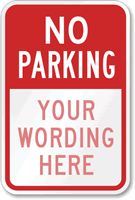
This material replaces glass beads with micro-prisms, making it 3x brighter than Engineer Grade. With a visibility range of 1,000 feet and a 10-year warranty, it is the new industry standard for No Parking signs or entrances where traffic moves faster than 10 MPH.
3. Diamond Grade (Type IX / XI)
This is the gold standard used for Interstate highways and school zones. It is 10x brighter than Engineer Grade and visible from over 1,500 feet away. We recommend this superior sheeting for critical safety markers like “Stop signs” or “Pedestrian Crossings” that must be seen instantly to prevent injury.

Why Reflectivity Matters for Your Business
It comes down to two factors: fire code compliance and legal enforceability. From a compliance standpoint, the International Fire Code (IFC) mandates that “Fire Lane No Parking“ signs be distinct and visible. If a sign is non-reflective and invisible at night, a fire marshal can cite your property for a code violation, as emergency crews need those lanes clear 24/7.
From a legal perspective, enforceability is key. In many jurisdictions, a “Tow-Away Zone“ sign is legally void at night if it is not retroreflective. If a driver fights a ticket by proving the sign was invisible in the dark, the property owner is often left footing the bill.
Why Trust MyParkingSign.com for Reflective Signs?
There are many places to buy cheap signs, but you should trust MyParkingSign.com for your safety needs. Why? Many budget retailers sell “reflective” signs made with generic tape that peels off after one season.
We are a certified partner of 3M. We use genuine 3M™ matched component systems, meaning the film, ink, and protective overlay are chemically engineered to work together. We print on rust-proof heavy-duty aluminum that withstands wind, snow, and UV rays. When you buy a High Intensity Prismatic sign from us, you get the full warranty and the peace of mind that your signs will remain compliant for years. Don’t risk your liability on a cheap imitation. Trust the parking sign experts.
Frequently Asked Questions (FAQ)
1. Are reflective parking signs legally required?
A. Yes, in most cases. The MUTCD (Manual on Uniform Traffic Control Devices) states that regulatory signs (like Stop, Yield, and Do Not Enter) installed on private property open to public travel must be retroreflective or illuminated. Additionally, local fire codes often require fire lane signs to be reflective so emergency responders can see them at night.
2. What is the real difference between Engineer Grade and High Intensity signs?
A. The brightness and distance. Engineer Grade uses older glass bead technology and is fine for slow parking lots. High Intensity Prismatic (HIP) uses micro-prisms, making it three times brighter and visible from double the distance. HIP also lasts longer (10 years) compared to Engineer Grade (7 years).
3. How can I test if my old signs are still reflective?
A. Try the “Flashlight Test.” Go outside at night, hold a bright flashlight right next to your eyes (nose level), and shine it at the sign. If the sign “lights up” or glows back at you, it is retroreflective. If it just looks like a flat, painted piece of metal, the sheeting has failed or was never reflective to begin with.
4. Can I just use non-reflective signs in my parking lot?
A. Only if the lot is fully lit 24/7. However, we do not recommend it. Even in well-lit lots, streetlights can burn out or power can fail. For your handicap parking and fire lane signs to be legally enforceable at all times, reflective signage is the only safe option.
Related Posts
 Pasadena uses parking meters to stop panhandling, help the homeless
 New York City’s parking signs get a facelift
 Don’t panic about ebola and public transit
 Signs of a Four-Way That Won’t Blink
 Accessible parking sign guerrillas strike Brooklyn
 How Carpool Parking Signs Encouraged Carpooling – Real Case Study
Category: Uncategorized