- Home
- Custom
- No Parking
- Handicap Parking
- Reserved Parking
- Parking Lot
- Private Property
- Posts, Hardware & More


The common types are the Narrow Bridge (W5-2) and One Lane Bridge (W5-3) warnings, the Bridge Ices Before Road (W8-13) condition warning, regulatory weight-limit and clearance signs, and emergency Bridge Out messages. Together they protect both the drivers crossing and the structure itself.
Because bridges are exposed to cold air on the top, the bottom, and the sides, they lose heat far faster than roads sitting on insulating ground — so they freeze while the rest of the road is only wet. That makes for hidden ice right on the span. The Bridge Ices Before Road sign (W8-13) warns drivers to ease off before they hit that patch.
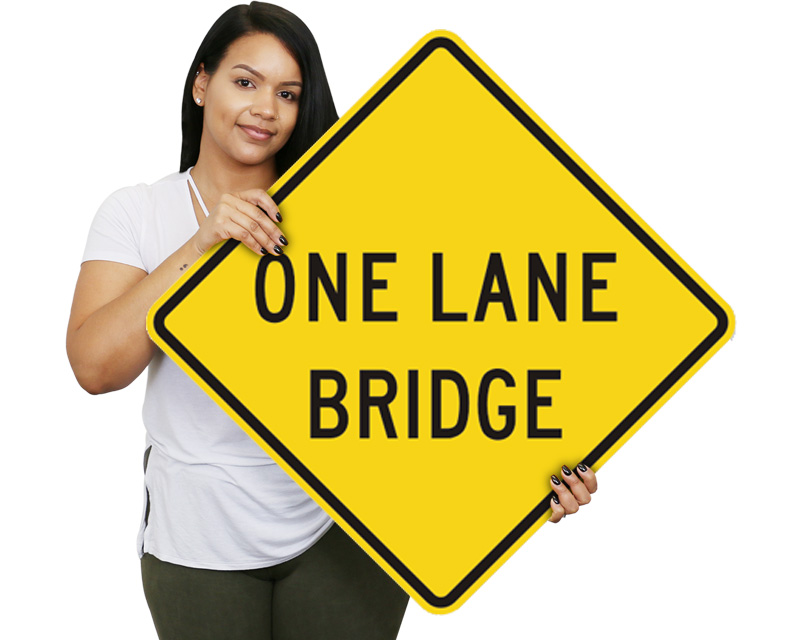
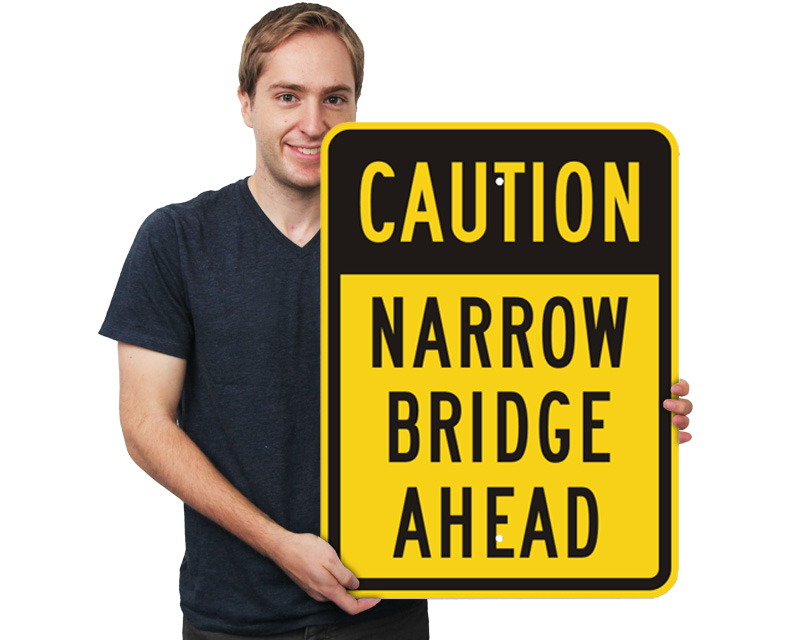
A Narrow Bridge sign (W5-2) warns that the bridge is tighter than the approaching lanes but still carries both directions — drivers need to hold their line. A One Lane Bridge sign (W5-3) means the span fits only one direction at a time, so traffic has to take turns. For the second, a Narrow Bridge Yield sign sets who goes first.
Yes. You can specify the exact tonnage — "10 Tons," an axle-weight limit, or a combination limit — to match your engineer's rating for a private or municipal bridge. These are regulatory-style signs, essential for keeping heavy trucks from overstressing the structure. Browse weight limit signs or call for a custom rating.
For a structure that's failed or unsafe, use an emergency message: Bridge Out, Bridge Out Ahead, Bridge Washed Out — No Access, or Bridge Closed. Post these in advance with a detour so drivers can turn off before they reach a gap in the road.
Often yes. The Narrow Bridge sign (W5-2) applies to a culvert as well as a bridge when its roadway clearance is 16 to 18 feet or narrower than the approach lanes. A culvert is just a smaller drainage structure carrying the road over a pipe or channel, but a driver still needs the same "it gets narrow here" warning, so the same sign does the job.
An overhead low railroad bridge is signed with a low clearance sign (W12-2) posting the height, so tall trucks know whether they fit. That's a different hazard from a low GROUND clearance crossing, where a long trailer can bottom out on a raised track — which uses the Railroad Low Ground Clearance sign (W10-5). Match the sign to whether the risk is overhead or underneath.
Yes — many bridges carry a name or memorial-designation plaque, and we can produce a custom sign with the bridge's name, number, or dedication. These are identification signs rather than warnings, so they don't follow a warning color, but they're built on the same rust-proof aluminum.
If a bridge sign is damaged, faded, or missing on a public road, report it to the agency that owns the road — your city or county public works or the state DOT — with the exact location. For a private bridge, you replace it yourself. For a bulk order or a custom sign, call our sales team at 888-343-3771 (Mon–Fri, 8am–7pm EST) or email customerservice@smartsign.com.
We make bridge signs: warning and regulatory signs that tell drivers what a bridge demands before they reach it — a narrow deck to squeeze through, one lane to share, a weight limit to respect, or ice that forms early. A bridge is a pinch point on the road: it's often narrower than the lanes leading up to it, it freezes before the pavement does, and it can only carry so much weight. A bridge sign turns each of those into advance notice, so a trucker, a plow driver, or a family in a minivan can adjust in time instead of discovering the hazard on the span.
Bridge signs follow the same MUTCD code as every other traffic sign, so the color and shape tell you the type before you read a word.
Call our sales team at (800) 952-1457 and get your quote in minutes!
Mon - Fri 8:00am to 7:00pm EST
Friendly service. Fast, affordable shipping on over 15,000+ products.
Happy customers are our top priority.
Lowest prices online.
Orders over $50 ship free!
Can't find what you need? Our signs are customizable to fit your needs.
Stock products ship in 1 day.
You can't beat our standards. 3M warranty.
Best price guarantee. Fast, free shipping.