
What Are the Legal Requirements for Custom Parking Signs?
A parking sign is only as effective as its legal standing. If your custom sign uses the wrong colors, missing required language, or sits at the wrong height, a towing company can refuse to remove a vehicle and your enforcement effort stalls completely. Understanding the legal requirements for custom parking signs protects your property, keeps drivers informed, and ensures you can actually act when someone violates your rules.
This guide covers what property managers, business owners, HOA boards, and municipalities need to know before ordering a custom sign. From MUTCD compliance and sign materials to tow away sign language and state-level variations, here is what the rules actually require.
Does a Custom Parking Sign Have to Follow MUTCD Standards?
The Manual on Uniform Traffic Control Devices (MUTCD), published by the Federal Highway Administration, sets the national standard for traffic and parking signs on public roads. If your lot connects to or is visible from a public street, MUTCD guidelines almost certainly apply to you.
Even on private property, MUTCD compliance matters for a practical reason: many towing companies and local ordinances require signs to meet recognized standards before a vehicle can be legally removed. A custom sign that ignores those standards can make enforcement difficult or impossible.
The core MUTCD requirements that apply to custom parking signs include:
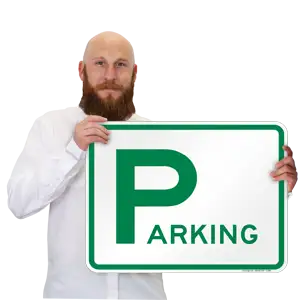
- White lettering and symbols on a green background for parking regulation signs, or black on white for no parking and restriction signs
- Retroreflective sheeting (ASTM Type I engineer-grade minimum) so signs are visible at night
- Standard sign dimensions: most parking signs are 12″ x 18″ or 18″ x 24″ depending on road speed and placement
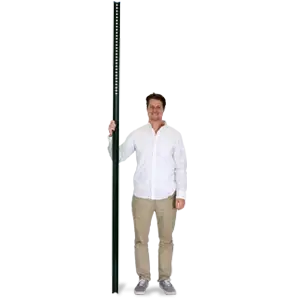
- Mounting height of at least seven feet from the ground to the bottom of the sign in pedestrian areas
If your property is entirely private with no public road access, some of these requirements may be advisory rather than mandatory. Still, following them strengthens your legal position if enforcement is ever challenged.
Color, Reflectivity, and Material Requirements for Custom Signs
The physical construction of a custom parking sign is not just a quality issue. It is often a compliance issue. Signs that fade, peel, or become unreadable in low light can be ruled inadequate for enforcement purposes.
a) Sign Materials That Meet Legal Standards
Heavy-gauge aluminum is the standard substrate for compliant parking signs. For most applications, .063″ thickness is the minimum acceptable gauge; .080″ aluminum is recommended for high-traffic or high-wind locations. Aluminum resists rust, holds up to UV exposure, and will not warp the way plastic or thin sheet metal does.
Avoid signs printed on corrugated plastic or thin steel. They may look adequate initially but fail quickly and may not satisfy a towing company’s standards for legal signage.
b) Reflectivity Requirements
MUTCD requires retroreflective sheeting on all traffic control signs that serve a regulatory function after dark. For most custom parking signs, engineer-grade reflective sheeting (ASTM Type I) meets the minimum requirement. High-intensity prismatic (HIP) sheeting is required on higher-speed roads and recommended anywhere nighttime visibility is a concern.
A sign that is only printed on non-reflective material technically does not meet federal standards for nighttime use. If your lot has any after-hours activity, reflective sheeting is not optional.
What Language Do Custom No Parking and Tow Away Signs Require?
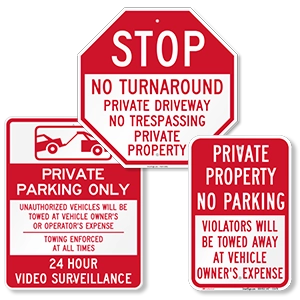
Sign wording is where most custom parking signs fall short. Vague language like “Private Parking” or “Violators Will Be Towed” without supporting details is often not enough. Most states and municipalities require specific information to be posted before a towing company will remove a vehicle.
a) Standard No Parking Sign Language
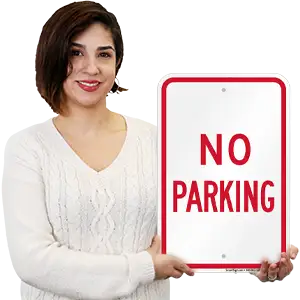
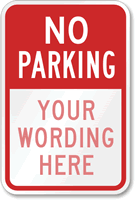
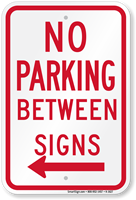
A compliant no parking sign typically needs to state the restriction clearly and, where applicable, include the hours and days it applies. “No Parking 7AM to 6PM Mon through Fri” is enforceable. “No Parking Anytime” is clear and enforceable. “Please Do Not Park Here” is neither.
b) Tow Away Sign Requirements
For tow away signs, most states require additional information before a towing company will legally remove a vehicle. This commonly includes:
- The name and phone number of the towing company authorized to remove vehicles
- The address where the vehicle will be towed
- A statement that unauthorized vehicles will be towed at the owner’s expense
Without this information posted, many towing operators will decline to remove a vehicle to avoid liability. Check your state’s specific towing statute for the exact language required. California, Texas, New York, and Florida each have distinct requirements that differ from federal guidance, so always verify with your local jurisdiction before finalizing sign text.
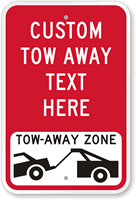
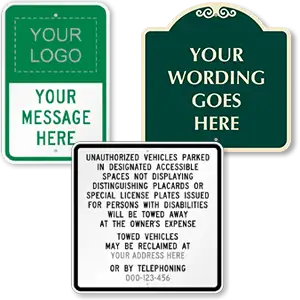
We offers tow away signs with state-specific compliant wording already built in, as well as fully customizable versions where you can add your towing company’s contact details.
ADA Requirements for Custom Accessible Parking Signs
If your lot includes accessible parking spaces, the 2010 ADA Standards for Accessible Design govern how those spaces must be marked. These are federal requirements with no private property exception for most commercial facilities open to the public.
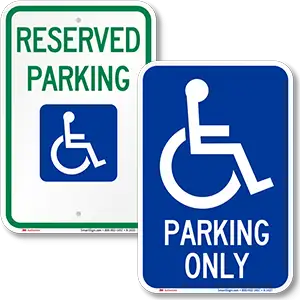
Each accessible space must be identified by a vertical sign displaying the International Symbol of Accessibility (ISA). The sign must be mounted so the bottom edge sits at least 60 inches above the ground. Van-accessible spaces require an additional “Van Accessible” sign mounted directly below or incorporated into the main sign.
Custom ADA handicap parking signs that change the ISA colors, alter the symbol proportions, or use non-standard mounting heights do not meet ADA standards. Fines for ADA non-compliance can reach thousands of dollars per violation in some jurisdictions, making this one area where deviating from standard requirements carries real risk.
Do You Need a Permit to Install Custom Parking Signs?
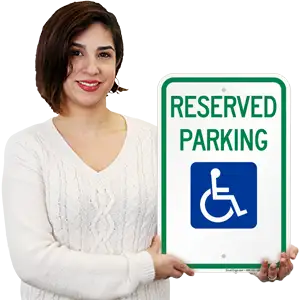
For signs on private property (parking lots, garages, and driveways), most jurisdictions do not require a permit for standard parking regulation signs, including reserved parking signs and fire lane markers. However, local zoning and sign ordinances can impose restrictions on sign size, placement, and the number of signs per property.
For signs installed in or adjacent to a public right-of-way, a permit from your local transportation or public works department is almost always required. Installing signs without a permit in a public right-of-way can result in the sign being removed at your expense.
When in doubt, contact your local planning or zoning department before installation. A quick call can prevent a costly mistake.
Get the Right Custom Parking Signs the First Time
Legal custom parking signs require the right materials, correct reflectivity, compliant wording, and proper mounting. Skipping any of these requirements weakens your enforcement ability and can expose you to liability. Whether you manage a small business lot, an HOA community, or a large commercial property, investing in compliant signage from the start saves time and money.
Browse our full range of custom parking signs to find fully customizable options built to MUTCD standards on heavy-gauge aluminum with engineer-grade reflective sheeting, ready to ship same day.
Frequently Asked Questions about Custom Parking Signs
Q : Does a custom parking sign on private property have to be MUTCD compliant?
A : MUTCD compliance is technically required only for signs on or adjacent to public roads. On strictly private property, it is not always mandated by law. However, many towing companies and local ordinances require signs to meet MUTCD or equivalent standards before they will remove a vehicle. Following MUTCD guidelines on private property protects your enforcement ability and reduces legal risk.
Q : What information does a tow away sign legally need to include?
A : Requirements vary by state, but most jurisdictions require the sign to identify the towing company by name and phone number, include the address where towed vehicles are taken, and state that vehicles are removed at the owner’s expense. California, Texas, New York, and Florida have specific statutory language requirements. Always verify with your local towing ordinance before posting signs.
Q : Can I use any colors I want on a custom parking sign?
A : No. MUTCD establishes specific color standards for regulatory signs. No parking and restriction signs use black text on a white background. Parking regulation signs use white on green. Deviating from these color conventions can make a sign non-compliant and weaken its legal enforceability. Custom elements like logos or property names can be added, but the regulatory text and background colors must follow the standard.
Related Posts
 Tupac’s Coachella Cameo: Groundbreaking for Traffic Signs, Too
 Recent study finds reasons to walk to school, and why certain kids aren’t
 10 months in: New York’s Vision Zero in comparison
 How hearing impaired drivers work at Lyft
 School Crossing Signs – Ensure Your Child’s Safety
 EIA: Gas prices don’t affect miles traveled
Category: Parking signs