
Is It Illegal to Put Up Your Own No Parking Sign?
 Few things are more frustrating than a stranger’s car parked in “your” spot, across your driveway, in front of your business, or hogging the curb where you always park. The obvious fix seems simple: buy a “No Parking” sign and stick it in the ground. But before you grab a drill, it’s worth knowing that whether that sign is legal, and whether anyone will actually enforce it, depends almost entirely on one question: who owns the ground it’s standing on.
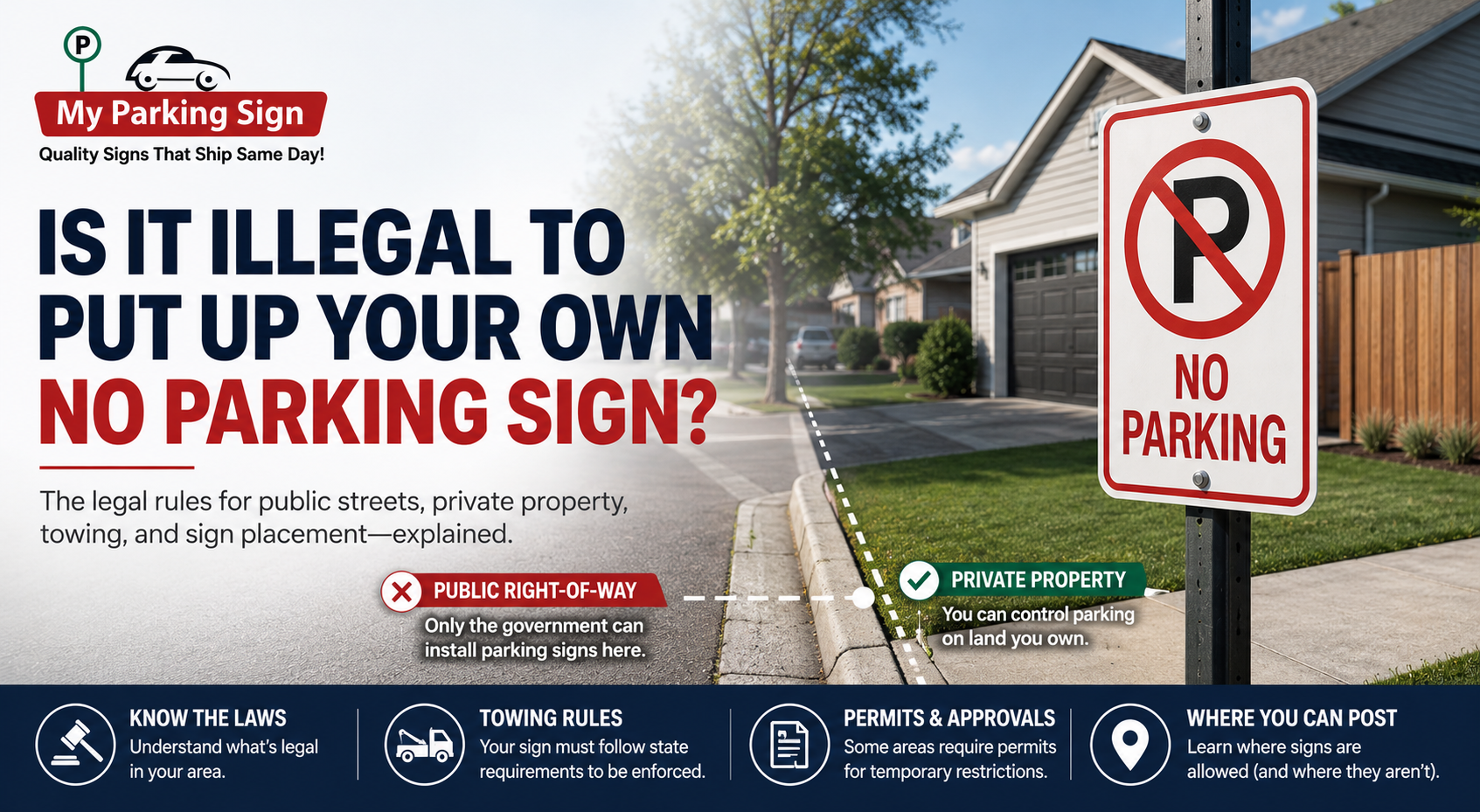
The short version: putting a “No Parking” sign on a public street, curb, sidewalk, or utility pole is illegal almost everywhere. Putting one on land you actually own is generally legal, but only if you follow your local rules. And here’s the part most people miss: even a perfectly legal sign on your own property may be worthless for getting a car towed unless it contains very specific language required by your state.
This guide breaks down the regulations, who has the authority to install signs, whether your sign can actually be enforced, and where you’re allowed to place one.
A quick note: Parking and signage laws are set at the state, county, and city level and vary widely. This article explains the general legal landscape in the United States and isn’t legal advice. Always confirm the rules with your local public works or transportation department before posting a sign.
No Parking Sign Regulations: The Legal Framework
To understand why a homemade sign carries no weight on a public street, you have to understand two concepts: the public right-of-way and the MUTCD.
The public right-of-way
Most homeowners assume their property runs all the way to the street. It usually doesn’t. Your legal property line typically stops well before the curb. The strip that includes the sidewalk, the planting strip (the grass between the sidewalk and the road), the curb, and the roadway itself is called the public right-of-way. Even though you mow that grass and shovel that sidewalk, the public, through your local government, controls it.
That distinction matters enormously. Because the right-of-way is public land, only a public authority can decide what regulatory signs go there. A “No Parking” sign you install on the curb in front of your house is, legally, an unauthorized object placed on land you don’t control.
The MUTCD: the rulebook for road signs
Every official traffic sign in the country answers to a single federal standard: the Manual on Uniform Traffic Control Devices (MUTCD), published by the Federal Highway Administration and adopted nationwide under federal regulation (23 CFR Part 655). It’s the reason a “No Parking” sign looks essentially the same in Maine as it does in Arizona: same colors, same shapes, same letter heights, and standardized codes (for example, an R7-1 is the standard “No Parking Any Time” sign).
Crucially, the MUTCD doesn’t just dictate how a sign looks. It states plainly that traffic control devices within the highway right-of-way may be placed only as authorized by the public authority with jurisdiction over that road. A sign installed by anyone else is, in the manual’s own terms, unofficial, even if it’s an exact replica you bought online. Buying an authentic-looking sign changes nothing about your legal authority to put it up.
So the regulation works on two levels: the right-of-way decides whose land it is, and the MUTCD decides who is allowed to regulate traffic there. On a public street, the answer to both is the government, not you.
Who Is Responsible for Installing No Parking Signs?
Authority depends on the type of land. Here’s how it breaks down.
a) Public streets: only the government
On any public road, curb, or right-of-way, the responsibility for placing, altering, and maintaining parking signs belongs to an authorized public agency, typically your city or county public works department or the state Department of Transportation (DOT). These agencies are charged with keeping signage consistent with state and federal law, managing traffic flow, and maintaining safety.
This authority is exclusive for a reason. If any resident could post binding traffic restrictions, streets would fill with conflicting, self-serving rules and no driver could trust any sign. The system only works if the signs come from one accountable source.
Many cities do offer official channels for residents who need temporary restrictions. Need a moving truck to park outside for a day, or want to reserve curb space for a construction dumpster? Cities frequently issue temporary no-parking permits for exactly that, but the city, not the resident, controls and installs the signage, usually after an application submitted several days in advance.
b) Private property: the owner, within limits
If you own a private driveway, parking lot, yard, or private road, you have a genuine right to control who parks there, and you can post No Parking signs to do it. This is where DIY signage is generally legal.
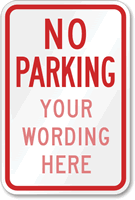
But “your property” must be exactly that. The sign has to sit entirely within your property lines. It can’t overhang the public sidewalk, and it can’t be placed where it blocks a driver’s sightline at an intersection or driveway. Businesses, commercial lots, and apartment complexes can manage their own parking too, but they’re often subject to additional local ordinances governing sign size, wording, and placement.
c) HOAs and shared lots: get approval first
If you live in a community governed by a homeowners association (HOA), or you manage a shared commercial lot, ownership gets more complicated. Common areas, private roads, and shared parking are usually controlled by the association, not the individual resident. Most HOAs regulate signage through their governing documents (the CC&Rs), and posting your own sign without approval can put you in violation of those rules, even on what feels like “your” street. Check the governing documents and get written approval before installing anything.
Are No Parking Signs Legally Enforceable?
This is the question that trips people up most, because a sign existing and a sign being enforceable are two very different things.
– On public streets: a fake sign does nothing
A “No Parking” sign you install on a public street has zero legal force. Parking enforcement officers and police only act on official restrictions that match local and state law. If a car is parked next to your homemade sign, an officer won’t ticket it, and if they notice the sign is unauthorized, they may remove it and could cite you for posting it.
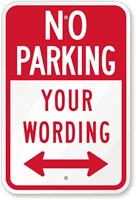
You also have no private remedy. You cannot legally call a tow truck to haul a stranger’s car off a public street. Private towing companies tow from private property; removing a car from a public street without police authorization can amount to vehicle theft. The bottom line: a DIY sign on a public street is, at best, decorative, and at worst, a liability.
– On private property: enforceable only if the sign is done right
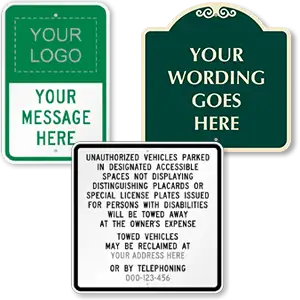
Here’s the nuance that surprises most property owners. Owning the land gives you the right to restrict parking, but a generic plastic “No Parking” sign from the hardware store is usually not enough to legally tow an offending vehicle.
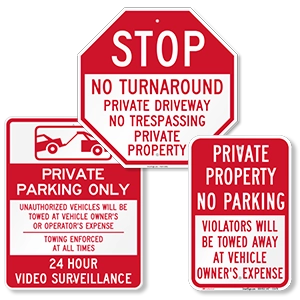
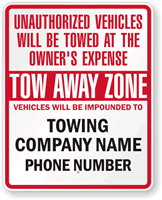
Most states have detailed tow-away signage statutes, and if your sign doesn’t meet them to the letter, the tow is unlawful and you can be liable for the towing costs and damages. While the specifics vary by state, compliant tow-away signs commonly must include:
1. A clear statement that unauthorized vehicles will be towed at the vehicle owner’s expense.
2. The name and telephone number of the towing company, and often the location where the vehicle can be reclaimed.
3. The relevant state vehicle code or local ordinance (for example, California’s CVC 22658).
4. Specific size, lettering height, color, and reflectivity requirements.
5. Posting at each vehicular entrance to the property, conspicuously and near the public right-of-way, not hidden at the back of the lot.
A few examples of how much this varies: California governs private-property towing under Vehicle Code 22658; Washington’s RCW 46.55.070 requires signs at each entrance listing the towing firm’s name, phone, and address; Utah adopted detailed color, dimension, and tow-logo specifications in 2021; and New Jersey, Kentucky, Texas, Georgia, and Virginia each have their own statutory wording. The practical lesson is the same everywhere: don’t assume a store-bought sign satisfies your state’s tow law. Confirm the exact requirements, and consider buying a state-specific tow-away sign rather than a generic one.
No Parking Sign Placement Guidelines
Where and how you mount a sign affects both its legality and whether it will hold up in a dispute. Placement rules differ between public and private land.
a) Getting an official sign placed on a public street
You can’t install one yourself, but you can petition the government to do it for you. If your street has a genuine problem, such as a blind curve, chronic congestion, a safety hazard, or people repeatedly blocking driveways, most cities have a formal process:
1. Talk to your neighbors; many cities want to see neighborhood support for a new restriction.
2. Submit a request to your city’s traffic engineering, public works, or transportation department with details about the problem.
3. The agency reviews the request and often conducts a site study to determine whether a restriction is warranted.
4. If approved, the city installs an official, MUTCD-compliant sign, sometimes for a small administrative fee. Some cities also offer painted curbs (red or yellow) instead of, or in addition to, a sign.
It’s slower than a trip to the hardware store, but it produces a sign that police will actually enforce.
b) Placing a sign on your own property
On private land, follow these general placement principles:
1. Stay inside your property lines. The entire sign must be on your land, with nothing overhanging the public sidewalk or street.
2. Make it visible. Post signs at entrances and other spots where approaching drivers will clearly see them before they park. For tow-away enforcement, signs typically need to be at every vehicle entrance.
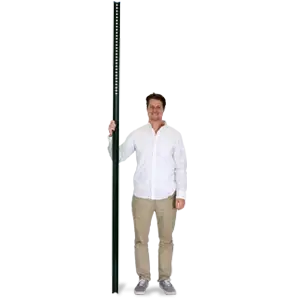
3. Mount it securely and high. Using screws and mounting signs out of easy reach deters tampering and theft, and many tow-away ordinances also specify a minimum height.
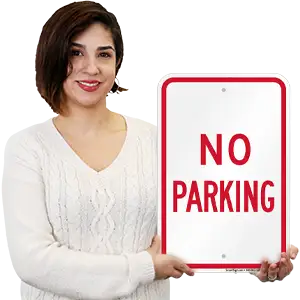
4. Use durable, reflective materials. Heavy-gauge aluminum no parking signs with reflective sheeting stay legible at night and in bad weather and last far longer than plastic. Reflectivity is a legal requirement under some ordinances.
5. Don’t obstruct sightlines. Keep signs clear of intersection and driveway visibility triangles.
c) Special cases: ADA accessible parking and fire lanes
Two situations carry their own strict, non-negotiable rules.
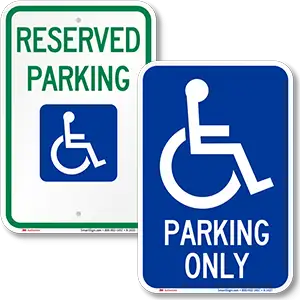
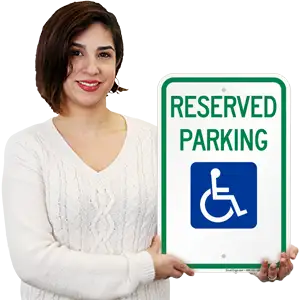
Accessible (ADA) parking. If you designate accessible spaces, the federal ADA Standards (Section 502.6) require each space to be marked with a sign bearing the International Symbol of Accessibility, mounted with its bottom edge at least 60 inches above the ground so it stays visible when a vehicle is parked in the space. Van-accessible spaces need an additional “Van Accessible” designation. The U.S. Access Board’s parking guidance confirms the ADA doesn’t fix the sign’s color or size, but many states add their own requirements, such as displaying a minimum fine amount on the sign. Importantly, a person with a valid disability placard generally must be allowed to use these spaces whether or not they’re your customer, and a “No Parking” sign can’t override that.
Fire lanes. Fire lanes must stay clear at all times for emergency access. Local fire codes typically require fire lanes to be painted (often red with “FIRE LANE” in white), marked with proper signage at intervals along the lane, and kept clear around hydrants. These are life-safety requirements, and violations carry their own penalties separate from ordinary parking rules.
Legal Alternatives When You Have a Real Parking Problem
If people keep parking where they shouldn’t on the public street near your home, you do have legitimate options. They just run through official channels:
1. Blocked driveway: You don’t own the street, but you do have a legal right to access your own property. In nearly every jurisdiction, blocking a driveway is illegal. Call your city’s non-emergency police or parking enforcement line; they can issue a ticket and authorize a tow.
2. Apply for a restriction: Petition the city for an official sign or painted curb, as described above.
3. Document the pattern: A log of dates, times, and photos strengthens your case when you ask the city to act.
These routes are slower than a homemade sign, but they’re the only ones that end with an enforceable result instead of a fine for you.
What Happens If You Post an Illegal Sign
Putting an unauthorized sign in the public right-of-way isn’t just ineffective. It can expose you to real penalties, depending on local ordinances:
1. Removal at no compensation. The city can take the sign down without notice, and you won’t be reimbursed.
2. Fines. Many cities fine unauthorized signage in the right-of-way, and signs posted improperly (wrong height, wrong material) can draw separate penalties.
3. Vandalism or defacement charges if you bolt or nail a sign to a utility pole, light post, or tree.
4. Encroachment for placing an unauthorized structure on public property.
5. Liability for an illegal tow. If you tow a car based on a non-compliant sign, the vehicle owner can pursue you for the costs and damages.
6. Rare, serious charges such as fraud or impersonation if a fake regulatory sign is used to deceive the public into thinking it’s official.
Frequently Asked Questions
Q : Can I put a “No Parking” sign in front of my house?
A : Not on the public street or curb, that’s the city’s call. You can post one on your own property (inside your property line), and you can petition the city to install an official sign on the street if there’s a genuine problem.
Q : Will police enforce a sign on my private property?
A : They may, but generally only if your sign meets your state’s specific tow-away requirements (towing company name and number, “at owner’s expense” language, the relevant code, and the right size and placement). A generic sign usually isn’t enough.
Q : Is a store-bought “No Parking” sign legal?
A : On your own private property, yes, as a notice. But to actually tow a vehicle, it almost always must include the additional state-mandated language above. On public property, no replica of an official sign is legal for you to install.
Q : Can I tow a car parked in front of my house on the street?
A : No. You can’t authorize a private tow from a public street. Call parking enforcement or non-emergency police, who can ticket and authorize a tow, especially if the car is blocking your driveway.
The Bottom Line
Whether it’s legal to put up your own “No Parking” sign comes down to ownership. On public streets, curbs, and the right-of-way, only your city, county, or state DOT can install enforceable signs, and a DIY version can cost you fines rather than solve your problem. On your own private property, you can post signs, but if your goal is to tow violators, the sign must satisfy your state’s detailed tow-away requirements to hold up.
When in doubt, two phone calls save a lot of trouble: one to your local public works or transportation department to confirm the rules, and one to a reputable sign supplier who can provide a compliant, state-specific sign built to the right standards. Doing it right the first time keeps your parking protected, your neighbors on good terms, and you on the right side of the law.
Related Posts
 Chris Hoogewerff of QuickPay talks parking, startups, and the app market
 QR Codes being added to Pay-by-Cell Parking Meters in Montgomery
 Los Angeles mayor responds to parking-ticket accusations
 VMTs on decline since ’92, with men driving most by far
 Local Business Owners Feel the Impact of Inexplicable No Parking Signs
 Despite awareness of risks, 91% of teens text while driving
Category: Parking signs