
Types of Parking Lot Signs and Their Uses
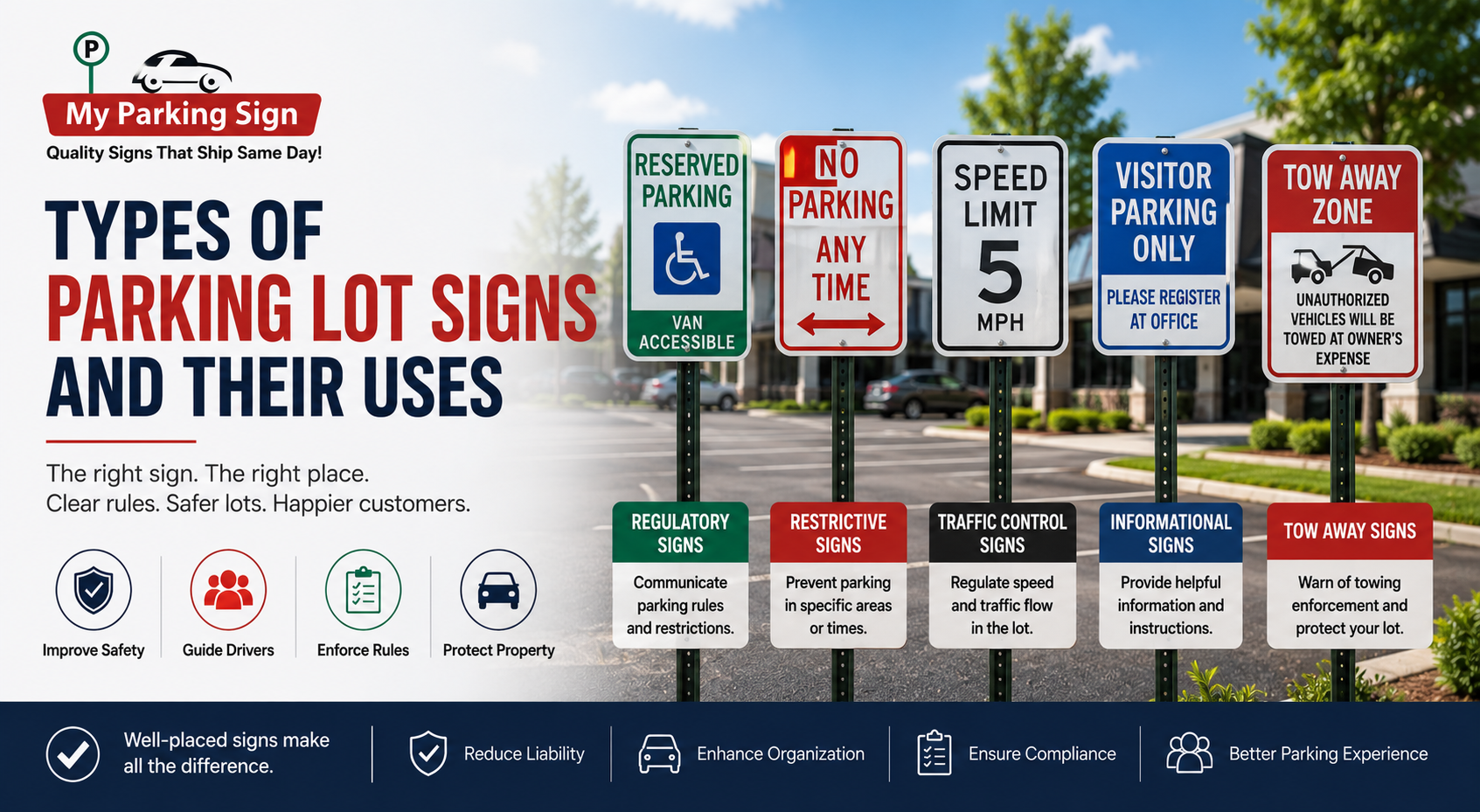 Walk through any well-run parking lot and you will notice one thing immediately: the right signs are in the right places. Drivers know where to go, which spaces are reserved, and what happens if they park where they should not. That clarity does not happen by accident. It comes from understanding the different types of parking lot signs, what each one does, and where it belongs. Whether you manage a strip mall, an office complex, an HOA community, or a municipal facility, this guide breaks down every major sign category and its purpose.
Regulatory Signs: The Foundation of Parking Lot Signage
Regulatory signs tell drivers what they are and are not allowed to do. These are the most legally significant signs in any parking lot. Posting them correctly is what gives you the authority to enforce parking rules, including towing.
1. No Parking Signs
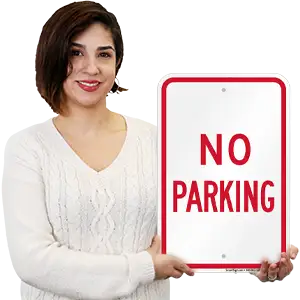
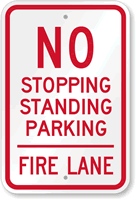
A no parking sign prohibits vehicles from stopping and leaving a driver. These signs are typically black text on a white background per MUTCD (Manual on Uniform Traffic Control Devices) standards. To be enforceable, they should specify whether the restriction applies at all times or only during certain hours and days.
No parking signs are commonly posted along fire access lanes, in front of loading docks, at building entrances, and along internal driveways where stopped vehicles would create a hazard.
2. No Standing and No Stopping Signs
These are stricter than no parking signs. A no standing sign means a driver cannot stop even briefly to pick someone up. A no stopping sign means the vehicle must keep moving entirely. These are more common in municipal or high-traffic commercial settings where any stopped vehicle creates a safety or flow problem.
3. Tow Away Signs
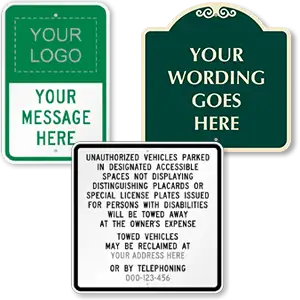
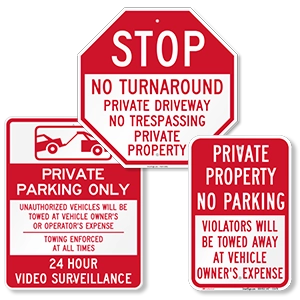
A tow away sign is your enforcement mechanism. It tells drivers that unauthorized vehicles will be removed at the owner’s expense. Most states require the sign to include the name and phone number of the authorized towing company and the address where towed vehicles are taken. Without this information posted, many towing operators will not remove a vehicle. Tow away signs work best when paired with no parking or reserved parking signs so the full restriction is clear.
Reserved and Designated Parking Signs
Reserved signs assign specific spaces to specific users. They reduce conflicts, protect spaces for intended users, and give your lot a professional, organized appearance.
1. Reserved Parking Signs
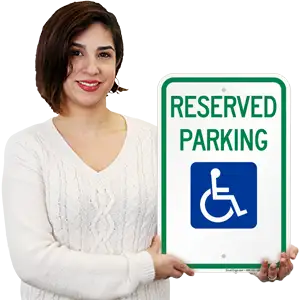
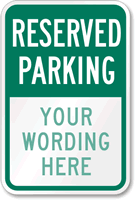
Reserved parking signs can be general (“Reserved Parking”) or person-specific (“Reserved for Building Manager”). They are widely used in office parks, apartment complexes, and retail lots where tenants or employees have assigned spaces. Custom versions let you add a name, unit number, or company logo for a polished, professional look.
2. ADA Handicap Parking Signs
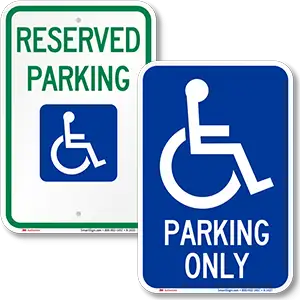
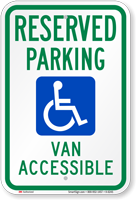
Any parking lot serving a facility open to the public is required by the Americans with Disabilities Act (ADA) to provide accessible spaces marked with the International Symbol of Accessibility (ISA). The 2010 ADA Standards for Accessible Design specify that the sign must be mounted vertically with its bottom edge at least 60 inches above the ground.
Van-accessible spaces require a secondary sign stating “Van Accessible,” either mounted below the ISA sign or incorporated into it. ADA handicap parking signs are not optional for covered facilities, and non-compliance can result in fines that reach thousands of dollars per space in some jurisdictions.
3. Visitor and Customer Parking Signs
Visitor parking signs direct guests to designated spaces while keeping employee or resident areas clear. These are especially useful in mixed-use lots where it is not immediately obvious where a first-time visitor should park. Clear visitor signage reduces circling, cuts down on complaints, and sets the right first impression for anyone arriving at your property.
Warning and Safety Signs for Parking Lots
Warning signs alert drivers and pedestrians to hazards or conditions they need to act on. They do not restrict parking directly but play a critical role in lot safety and liability management.
1. Speed Limit Signs
Parking lots are not governed by posted public road speed limits, which means you set the speed limit for your property. Most lots post five or ten miles per hour limits. A clearly posted speed limit establishes the standard of care for your property, which matters if an accident or injury ever results in a liability claim.
2. Speed Bump and Speed Hump Signs
Any time a physical traffic calming device is installed, it should be signed in advance. Drivers who hit an unmarked speed bump can claim the hazard was not disclosed. Pairing speed bump signs with the physical device reduces that risk and gives drivers time to slow down before they reach it.
3. Pedestrian Crossing Signs
Wherever pedestrian paths cross vehicle travel lanes, a crossing sign warns drivers to yield. These signs are particularly important near building entrances, crosswalks, and areas with high foot traffic such as shopping center lots or school pick-up zones.
Directional and Informational Parking Lot Signs
Directional signs guide drivers through your lot efficiently. A well-signed lot reduces the chance of wrong-way entry, head-on conflicts, and driver frustration. These signs do not carry the same enforcement weight as regulatory signs, but they directly affect how smoothly your lot operates.
1. Entrance and Exit Signs
Entrance and exit signs tell drivers where to enter and leave. In lots with multiple access points, clear entrance and exit signs prevent drivers from entering the wrong way, which is a common cause of near-miss incidents in busy parking areas.
2. One-Way and Do Not Enter Signs
One-way signs establish traffic flow patterns in lots with narrow lanes or angled parking. A do not enter sign reinforces an exit-only lane or prevents drivers from cutting through restricted areas. These signs follow standard MUTCD color conventions: white on red for do not enter, black on white with an arrow for one-way.
3. Parking Lot Directional Signs
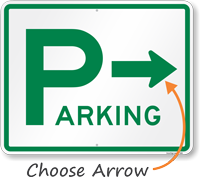
Parking lot directional signs guide drivers to specific areas within a large lot. Common examples include signs pointing toward overflow parking, numbered sections in a garage, or specific entrances to a building. In multi-level garages or large surface lots, these signs are essential for preventing driver confusion and reducing traffic congestion inside the facility.
Fire Lane Signs: A Legal Requirement, Not Just a Convenience
Fire lane signs designate areas that must remain clear for emergency vehicle access at all times. They are not discretionary. Local fire codes in most jurisdictions require fire lanes to be marked with both signage and painted curbing, and failure to maintain clear fire lanes can result in code violations and fines against the property owner, not just the vehicle blocking the lane.
A compliant fire lane sign typically reads “Fire Lane, No Parking Anytime” and must be posted at regular intervals along the designated zone. The exact spacing and wording requirements vary by municipality, so check with your local fire marshal for the specific standards that apply to your property.
Fire lane signs work best as part of a complete system: signage posted at the correct height, red curb paint where required, and tow away signs nearby to reinforce enforcement. A towing company is much more likely to remove a vehicle blocking a fire lane when all three elements are in place.
Build a Complete Parking Lot Signage System
Every parking lot needs a mix of regulatory, reserved, warning, directional, and safety signs working together. Missing even one category creates confusion, weakens enforcement, or opens your property to liability. The good news is that the right signs are straightforward to identify once you know what each type does.
We offer the full range of parking lot signs your property needs, from standard regulatory signs built to MUTCD specs on heavy-gauge aluminum to fully custom signs with your property name, logo, or towing company details. Shop the complete collection and get your order shipped the same day.
Frequently Asked Questions
Q : What are the most important signs for a private parking lot?
A : Every private parking lot should have, at minimum, no parking signs for restricted areas, reserved signs for assigned spaces, a tow away sign with towing company contact information, and fire lane signs wherever emergency access must be kept clear. If the lot serves a public-facing facility, ADA handicap parking signs are also federally required. These five sign types cover the core legal and safety requirements for most properties.
Q : Do parking lot signs need to be reflective?
A : For any lot with after-hours activity, yes. MUTCD requires retroreflective sheeting on regulatory signs that serve a traffic control function at night. Engineer-grade reflective sheeting (ASTM Type I) meets the minimum standard for most parking applications. High-intensity prismatic (HIP) sheeting provides greater visibility and is recommended for high-speed entry lanes or poorly lit lots.
Q : How many ADA parking spaces does my lot require?
A : The 2010 ADA Standards for Accessible Design set minimum ratios based on total lot size. A lot with one to 25 total spaces requires one accessible space. Lots with 26 to 50 spaces require two, and the number scales up from there. At least one space in every six accessible spaces must be van-accessible. Check the ADA’s current standards or consult a compliance professional to verify the exact count for your facility.
Related Posts



Category: Parking signs