
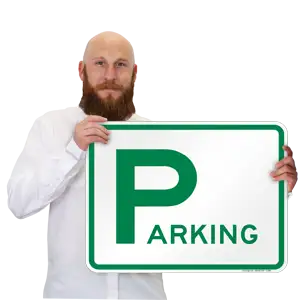
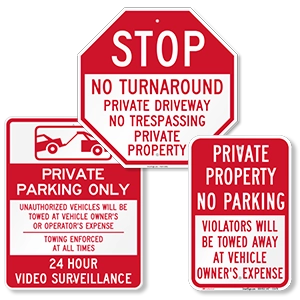

11 Signs That Every Parking Lot Should Have
Most parking lot problems start with missing signs. A driver parks in a reserved space because nothing told them not to. A towing company refuses to remove a violator because the right signage was never posted. An ADA compliance inspection turns up a fine because a handicap sign was mounted at the wrong height. The signs every parking lot should have are not complicated, but skipping even one creates gaps in safety, enforcement, and legal compliance. Here is the complete list, with what each sign does and why it belongs in your lot.
Regulatory Signs Your Lot Cannot Do Without
Regulatory signs carry legal weight. They define what drivers are and are not permitted to do, and they form the backbone of any enforceable parking policy.
1. No Parking Signs
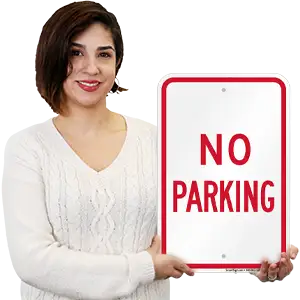
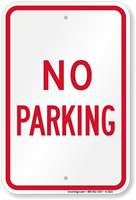
No parking signs are the single most common sign in any commercial or residential lot. They mark areas where stopping and leaving a vehicle is prohibited, including loading zones, fire access lanes, building entrances, and internal driveways. A compliant no parking sign uses black text on a white background per MUTCD standards and clearly states whether the restriction is in effect at all times or only during specific hours.
Without a posted no parking sign, you have no legal basis to tow a vehicle from that area. The sign is not just a courtesy. It is a requirement.
2. Tow Away Signs
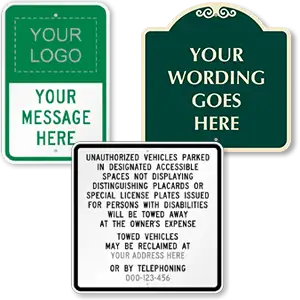
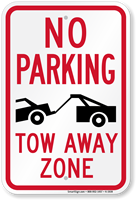
A tow away sign gives your no parking rules teeth. Most towing companies will not remove a vehicle unless a tow away sign is posted in the area, and most states require the sign to include the name and phone number of the authorized towing company plus the address where vehicles are taken.
Post tow away signs at every lot entrance and alongside no parking signs in high-violation areas. The combination of a no parking sign and a tow away sign is the standard two-sign enforcement setup used by property managers across the country.
3. Reserved Parking Signs
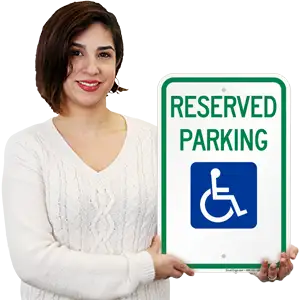
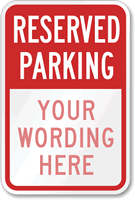
Reserved parking signs assign specific spaces to specific users, whether that is a tenant, an employee, a building manager, or a designated role like “Delivery Vehicles Only.” They reduce conflicts between drivers competing for the same space and make your lot easier to manage.
Custom reserved signs with a person’s name, unit number, or company logo go one step further. They make ownership of a space immediately obvious and discourage unauthorized parking more effectively than a generic sign alone.
ADA and Accessibility Signs: Federal Requirements, Not Optional Additions
Any parking lot serving a facility open to the public must comply with the 2010 ADA Standards for Accessible Design. These requirements are federally mandated and carry real financial penalties for non-compliance.
4. ADA Handicap Parking Signs
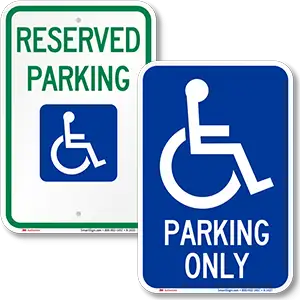
ADA handicap parking signs must display the International Symbol of Accessibility (ISA) and be mounted vertically with the bottom edge at least 60 inches above the ground. The number of accessible spaces required scales with total lot size: one space for lots with one to 25 total spaces, two for 26 to 50, and so on per the ADA Standards.
Custom ISA colors or non-standard symbol proportions do not meet ADA requirements. Fines for non-compliant accessible parking can reach thousands of dollars per violation in some jurisdictions, so this is one area where following the standard exactly is essential.
5. Van Accessible Signs
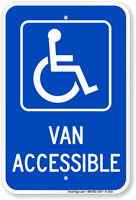
At least one in every six accessible spaces must be van-accessible under ADA rules. Each van-accessible space requires a secondary sign reading “Van Accessible,” mounted either below the main ISA sign or incorporated into it. Van-accessible spaces need a wider access aisle (96 inches minimum) to accommodate wheelchair lift-equipped vehicles.
Many property managers overlook this requirement until an inspection flags it. Check your accessible space count and confirm that the correct number carry van-accessible designation before it becomes a compliance issue.
Fire Lane and Safety Signs That Protect Your Property
Safety signs in a parking lot do more than protect drivers and pedestrians. They protect you from liability. A property with clear, visible safety signage demonstrates a standard of care that matters if an accident or injury ever results in a legal claim.
6. Fire Lane Signs
Fire lane signs are legally required in most jurisdictions wherever emergency vehicle access must remain clear. Local fire codes typically mandate both signage and red curb paint along designated fire lanes, with signs posted at regular intervals. The exact spacing and wording requirements vary by municipality, so verify with your local fire marshal.
A vehicle blocking a fire lane can prevent emergency responders from reaching a building. Post fire lane signs at every entry point to the zone and pair them with a tow away sign to make enforcement immediate and clear.
7. Speed Limit Signs
Public road speed limits do not automatically apply to private parking lots. That means the speed limit in your lot is whatever you post. Most lots set a limit of five or ten miles per hour. A clearly posted speed limit signs establishes the standard of care for your property and creates a documented rule that drivers are expected to follow.
In the event of an accident involving a speeding vehicle, a posted speed limit sign is one of the first things a liability attorney will look for. If it is not there, the absence works against you.
Directional Signs That Keep Traffic Moving Safely
Directional signs do not carry the same enforcement weight as regulatory signs, but they directly affect how safely and efficiently your lot operates. A confused driver is a hazard. Clear directional signage removes the confusion.
8. Entrance and Exit Signs
Every access point to your lot should be clearly marked as an entrance or an exit. In lots with multiple openings, unmarked access points invite wrong-way entry, which is one of the most common causes of low-speed collisions in parking areas. Entrance and exit signs are inexpensive, easy to install, and immediately reduce driver confusion.
9. One-Way Traffic Signs
Lots with angled parking or narrow lanes almost always need one-way traffic flow to function safely. One-way signs follow MUTCD conventions: black arrow on a white background, mounted at decision points where a driver might otherwise turn the wrong direction. Pair them with do not enter signs at the exit end of each one-way lane for a complete traffic flow system.
Informational Signs That Reduce Complaints and Confusion
Informational signs set expectations before a driver parks. They answer the questions drivers ask most: Who can park here? For how long? What happens if I park in the wrong spot? Clear answers posted at the right locations reduce complaints, disputes, and the awkward conversations that come with enforcing rules that were never clearly communicated.
10. Visitor Parking Signs
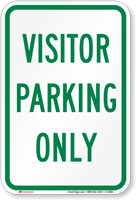
In mixed-use lots where employees, tenants, and visitors all share the same space, a visitor parking sign prevents the spaces intended for guests from being absorbed by regular users. Visitor parking signs are especially useful in office parks, medical buildings, and apartment complexes where turnover in visitor spaces needs to stay high.
Visitor parking signs can be standard or custom. Adding “2-Hour Limit” or “Visitor Parking Only, Residents Will Be Towed” makes the sign do double duty as both an informational sign and an enforcement tool.
11. Parking Time Limit Signs
Time limit signs manage space turnover in high-demand lots. A “2-Hour Parking” sign in a retail lot keeps customer spaces available throughout the day and prevents employees or nearby residents from occupying customer spots all day. Time limit signs work best when they clearly state the hours and days the limit applies, such as “2-Hour Parking, 8AM to 6PM, Mon through Sat.”
Without stated hours, the restriction is ambiguous and harder to enforce. Specific, clearly worded time limits leave no room for interpretation.
Start With the Right Signs and Build From There
Every parking lot is different, but the 11 signs covered here apply to nearly every property, whether you manage 10 spaces or 1,000. No parking, tow away, ADA handicap, fire lane, directional, and informational signs work together as a system. Gaps in that system create enforcement problems, liability exposure, and driver frustration.
We carries every sign on this list, built to MUTCD standards on heavy-gauge aluminum with engineer-grade reflective sheeting. Browse the full range of parking lot signs, including standard and fully custom options, and get your order shipped the same day.
Frequently Asked Questions
What signs are legally required in a parking lot?
The legally required signs in a parking lot depend on your property type and local ordinances, but most lots need at minimum: ADA handicap parking signs for accessible spaces (federally required for facilities open to the public), fire lane signs where emergency access must be kept clear (required by local fire codes), and tow away signs if you intend to tow unauthorized vehicles. No parking and reserved signs are not always mandated by law but are required in practice for enforcement to be possible.
How many ADA parking spaces does my lot need?
The 2010 ADA Standards for Accessible Design set minimum counts based on total lot size. Lots with one to 25 spaces need one accessible space. Lots with 26 to 50 spaces need two. The count increases incrementally from there. At least one in every six accessible spaces must be van-accessible. Consult the full ADA Standards or a compliance professional to confirm the exact count for your facility.
Do I need a tow away sign to legally tow a vehicle?
In most states, yes. Towing companies are typically required to see a posted tow away sign before removing a vehicle from private property. Many states also require the sign to include the towing company’s name, phone number, and the address where towed vehicles are held. Without a compliant tow away sign posted in the area, a towing company may legally refuse to remove the vehicle, and you may have limited recourse if challenged.





Category: No Parking, Parking signs