
Types of Handicap Parking Signs & How To Buy Them
Handicap parking signs do more than mark a space. They keep accessible spots open for the people who need them, they protect you from compliance complaints and lawsuits, and in many states they are what gives police and tow operators the authority to act. But “handicap parking sign” isn’t a single product. There are standard reserved signs, van-accessible signs, fine and tow-away panels, state-specific designs, and directional add-ons, and using the wrong one can leave a space non-compliant even when a sign is clearly posted.
This guide walks through the main types of handicap parking signs, what makes a sign legally compliant, and how to choose and buy the right one for your lot.
A quick note on terminology: “Accessible” is the term used in the Americans with Disabilities Act, while “handicap” is the older word most people still search for. We use both here because they refer to the same signs.
The Different Types of Handicap Parking Signs
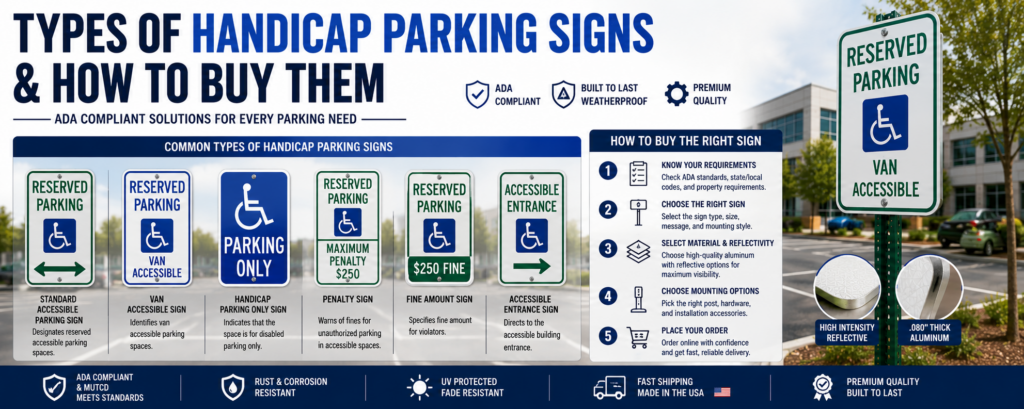
Most accessible spaces are marked with a primary sign plus one or more add-on panels mounted below it. Here are the types you’ll choose from.
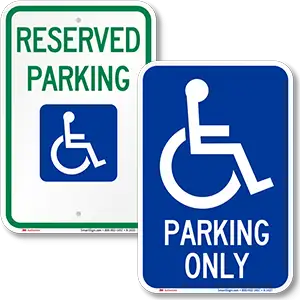
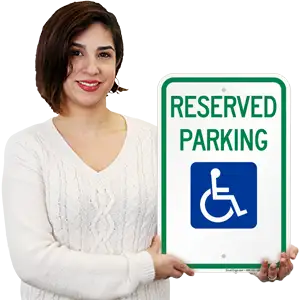
1. Standard accessible (reserved) signs : This is the core sign for any accessible space, based on the federal MUTCD R7-8. It shows the International Symbol of Accessibility (the white wheelchair on a blue field) and typically reads “Reserved Parking” or “Parking by Disabled Permit Only.” Every designated accessible stall needs one of these.
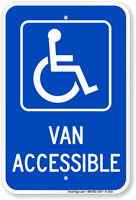
2. Van-accessible signs : Van spaces require everything a standard accessible space needs, plus a “Van Accessible” designation. This is usually a smaller add-on panel mounted directly beneath the main sign, and it signals the wider access aisle and extra vertical clearance that van spaces provide. At least one of every several accessible spaces generally must be van accessible, so most lots need these.
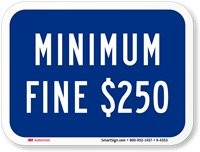
3. Fine-amount signs : Many states require the penalty for illegal parking to appear on or below the main sign, with legends like “$250 Fine” or “Minimum Fine $250.” These small plaques give enforcement real teeth and discourage drivers who assume a quick errand won’t matter. Whether you need one, and the exact amount, depends on your state.
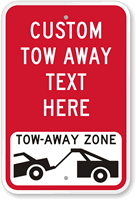
4. Tow-away signs : Where towing is part of enforcement, a tow-away panel warns that unauthorized vehicles will be removed at the owner’s expense. In some states these must also include the towing company’s name and phone number, the location to reclaim the vehicle, and the relevant vehicle code (for example, California’s CVC 22658). A generic “customers only” tow sign usually will not satisfy these requirements for an accessible space.
5. State-specific signs : Several states mandate their own exact wording, colors, sizes, and statute references. California uses a defined R99/R100 series with “Minimum Fine $250” and tow-away language; Florida and Illinois require specific fine wording; Texas requires the ISA plus a reference to its Transportation Code; and Virginia localities may require an ordinance number on the sign to enable towing. New York and Connecticut also accept the newer Dynamic Symbol of Accessibility, which is not part of the current federal ADA standard, so it should only be used where a state specifically permits it.
6. Directional arrow signs : When accessible stalls sit around a corner, behind an island, or down a long row, a left, right, or double-arrow panel points drivers (and enforcement) toward the right space. These aren’t always legally required, but they sharply reduce confusion and illegal parking in access aisles.
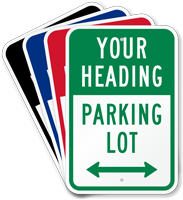
7. Permit-required signs : These spell out that only vehicles displaying a valid disabled placard or plate may park, often with “Permit Required” or “24/7” language. They reinforce the reserved status of the space and support enforcement.
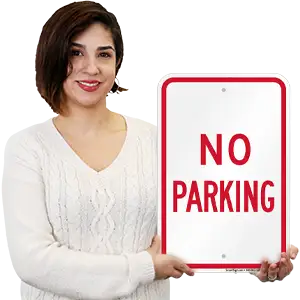
8. Access aisle “No Parking” signs : The striped aisle next to an accessible space must stay clear so users can deploy ramps and lifts. A small “No Parking” marker for the access aisle keeps that zone open and is an easy way to prevent a common and dangerous violation.
What Makes a Handicap Parking Sign Compliant
Before you buy, it helps to know the baseline rules. Federal ADA standards set the floor, the MUTCD governs design, and your state and city may add requirements on top.
1. The accessibility symbol. Every accessible space must be marked with a sign displaying the International Symbol of Accessibility. Van spaces add the “Van Accessible” designation.
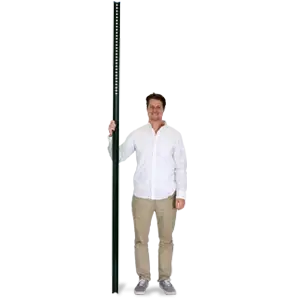
2. Mounting height. Under the ADA Standards (Section 502.6), the bottom edge of the sign must sit at least 60 inches above the ground so it stays visible when a vehicle is parked in the space. Indoors, where clearance is tight, some jurisdictions allow a lower mount as long as headroom for lifts is preserved.
3. Size and reflectivity. A 12-inch by 18-inch panel is the common minimum, with larger sizes used where drivers view signs from a distance. Reflective sheeting is strongly recommended (and sometimes required) so signs stay legible at night.
4. Number of accessible spaces. The ADA sets a minimum number of accessible spaces based on lot size, and a share of those must be van accessible. Smaller lots may need only one accessible space; large lots need several. Your local code enforcement office can confirm the exact count for your property.
5. State and local add-ons. Fine amounts, tow-away wording, statute references, and specific colors vary by state. These are not optional where required, so always check before ordering.
How To Buy the Right Handicap Parking Sign
Choosing a compliant sign comes down to matching the right design to your space and your jurisdiction. Here’s how to get it right the first time.
1. Match the sign to the space. A standard accessible sign covers most car stalls. Add a van accessible panel for van spaces, an arrow panel where stalls are hard to find, and an access-aisle “No Parking” marker beside the striped aisle. Map out each space before you order so nothing is missed.
2. Confirm your state’s requirements. This is the step most people skip. Check whether your state requires a fine amount, tow-away language, a statute reference, or a particular sign series. If your property spans multiple states, a single one-size-fits-all sign rarely works, so order state-specific handicap parking signs for each location.
3. Choose the right material and reflective grade. For outdoor use, heavy-gauge aluminum (around .080 inch) resists rust and weather and lasts for years. Engineer-grade reflective film is a solid baseline; high-intensity prismatic sheeting costs a little more but stays brighter and tends to last longer, which lowers liability in dim lots. Lightweight plastic is best reserved for short-term or indoor use.
4. Get the size and mounting height right. Order at least the 12-inch by 18-inch minimum (larger for high-distance viewing), and mount the bottom edge at least 60 inches above the pavement. Measure from finished grade, not the curb.
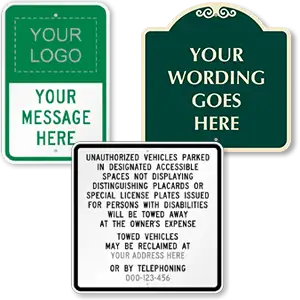
5. Customize where the law requires it. If your state mandates a tow-away sign, you’ll often need to add the towing company’s name and phone number, the reclaim location, and the code reference directly on the sign. Our custom handicap parking signs let you add that wording, fine amounts, names, or logos so the finished panel is compliant out of the box.
6. Order enough signs. Plan for one primary sign per accessible space, plus the van, fine, tow-away, arrow, or access-aisle panels each space needs. Pavement markings and stencils are a useful complement that reinforce the message from a distance.
Get Compliant Handicap Parking Signs
We carry the full range of accessible parking signs, from standard ADA and van accessible designs to fine amount signs, tow-away signs, directional panels, and state-specific options for California, Florida, Texas, New York, and more. Every sign is built from durable, reflective materials made to meet ADA and MUTCD standards, and our custom design tools let you add the exact wording your jurisdiction requires. Whether you need a single replacement sign or signage for an entire lot, you can design, preview, and order online in minutes.
Frequently Asked Questions
Q : What is the most common type of handicap parking sign?
A : The standard accessible (reserved) sign with the International Symbol of Accessibility, based on the MUTCD R7-8, is the core sign used to mark almost every accessible space. Van spaces add a “Van Accessible” panel below it.
Q : Do handicap parking signs need a fine amount on them?
A : It depends on your state. Some states, such as California, Florida, and Illinois, require the penalty amount on or below the sign, while others do not. Check your state and local requirements before ordering.
Q : How high should a handicap parking sign be mounted?
A : The ADA requires the bottom edge of the sign to be at least 60 inches above the ground so it stays visible when a vehicle is parked in the space. Measure from finished grade.
Q : Can I buy a custom handicap parking sign?
A : Yes. Custom signs let you add state-required tow-away or fine language, the towing company’s contact details, names, or logos. This is often necessary to make a sign enforceable on private property.
Q : What size should a handicap parking sign be?
A : A 12-inch by 18-inch panel is the common minimum, with larger sizes used where drivers need to read the sign from farther away. Add-on plaques like fine or van-accessible panels are typically smaller, around 6 inches by 12 inches.
Related Posts




Category: Handicap Parking