

What to Know About Federal Accessible Parking Signs
As a facility manager or business owner, you invest heavily in making your property welcoming. You have ensured your entrance is barrier-free and your restrooms are compliant. You likely even have the blue wheelchair symbol painted on your parking lot pavement. But have you checked your vertical signage lately?
While pavement markings are helpful, they are not enough to meet federal law. The Americans with Disabilities Act (ADA) requires specific federal accessible parking signs to identify these reserved spaces. If your signs are faded, mounted too low, or use the wrong wording, you could be unintentionally excluding customers and opening your business up to significant liability.
What Are Federal Accessible Parking Signs?
Before diving into the technical details, it is important to understand what makes a sign “federal.” The Manual on Uniform Traffic Control Devices (MUTCD), published by the Federal Highway Administration, standardizes road signs across the country. This ensures that a driver from Oregon recognizes a parking sign in Florida immediately.
ADA parking signs are regulatory devices that reserve specific spaces for individuals with disabilities. Unlike general information signs, these have the force of law. They must feature the International Symbol of Accessibility (the familiar wheelchair icon) and specific color schemes to be legally valid. These signs are the primary way a business communicates that it respects the civil rights of drivers with disabilities.
Shop MyParkingSign.com ADA Signs:
-
Reserved Parking (R7-8) Signs
-
“Van Accessible” Riders
-
State Specific Penalty Signs
-
U-Channel Posts & Hardware
What Are the Federal Requirements?
The Department of Justice and the Department of Transportation maintain strict standards for these signs. It is not enough to simply buy a sign that says “Handicap Parking.” To be fully compliant with the ADA Standards for Accessible Design, your signage must meet three critical criteria.
1. The R7-8 Design Standard
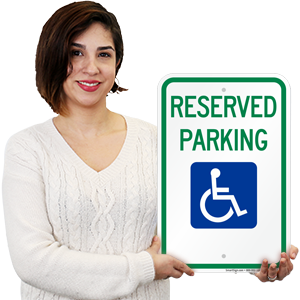
The only federally approved design for a standard accessible space is the R7-8 sign.
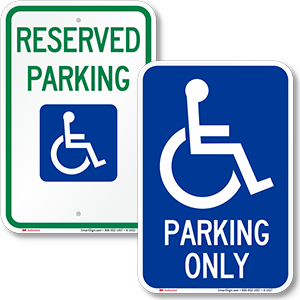
i) Color: It must have a white background with green legend (text) and a blue square containing the white International Symbol of Accessibility.
ii) Text: It must generally read “Reserved Parking.”
iii) Reflectivity: Because parking lots operate at night, the sign must be retroreflective so it is visible under headlights.
2. Van Accessible Designation
The ADA requires that for every six accessible spaces, at least one must be a “van accessible” space. This space is wider to accommodate a wheelchair lift.
i) The Requirement: You must mount a separate “Van Accessible” rider (Sign R7-8a) below the main Reserved Parking sign.
ii) Why it Matters: Without this sign, a sedan might park in a van spot, preventing a van user from deploying their ramp and exiting their vehicle.
3. Height and Visibility
A sign is useless if it is hidden behind a parked SUV.
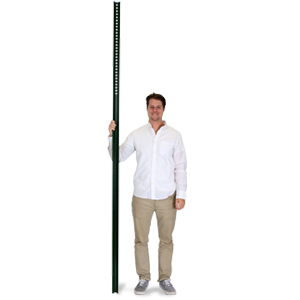
i) The Requirement: The ADA sign height rule mandates that the bottom edge of the sign must be at least 60 inches (5 feet) above the ground.
ii) Pedestrian Areas: If the sign is placed on a sidewalk where people walk, the height requirement increases to 84 inches (7 feet) to prevent pedestrians from hitting their heads on the metal edges.
Why Compliant Signage Matters for Your Business
According to the Centers for Disease Control and Prevention (CDC), 61 million adults in the United States live with a disability. By maintaining proper handicap parking signs, you are sending a clear message that these customers are valued and welcome at your establishment.
However, compliance is also about protecting your bottom line. Violating the ADA is a serious offense. Federal civil penalties for a first violation can be as high as $75,000, with subsequent violations reaching $150,000. This does not include the cost of potential private lawsuits or the damage to your brand’s reputation.
Conducting a simple audit of your parking lot is far cheaper than a federal fine. Check your signs for fading, ensure they are at the proper height, and verify you have the correct van accessible markers.
Why Trust MyParkingSign.com for ADA Parking Signs?
You might be tempted to buy a generic parking sign from a local hardware store, but that often leads to problems. Many generic signs fade within a year or use non-compliant fonts and colors that fail inspection.
MyParkingSign.com is the industry leader dedicated specifically to parking control. We manufacture our signs using 3M™ reflective sheeting and rust-proof aluminum that is designed to last over 10 years outside. We guarantee our R7-8 signs meet federal MUTCD specifications, so you never have to worry if your lot is up to code. Don’t risk your compliance on a cheap imitation. Trust the parking sign experts.
Frequently Asked Questions (FAQ)
1. What is the standard size for an ADA parking sign?
A. Typically 12 by 18 inches. While the MUTCD allows for some variation based on viewing distance, the standard size for a Reserved Parking (R7-8) sign in a parking lot is 12 inches wide by 18 inches tall. This ensures the text and symbol are large enough to be seen by a driver entering the space.
2. Do I need a “Van Accessible” sign on every space?
A. No, only on designated van spaces. Federal law requires that one out of every six accessible parking spaces be designated as “Van Accessible.” Only these specific, wider spaces require the additional “Van Accessible” rider mounted below the main sign.
3. Can I paint the wheelchair symbol on the ground instead of using a sign?
A. No, vertical signs are mandatory. While painting the International Symbol of Accessibility on the pavement is a helpful visual aid, the ADA Standards explicitly state that accessible spaces must be identified by signs. Pavement markings can be covered by snow, leaves, or the vehicle itself, making vertical signage the only legal requirement.
4. How high must the sign be mounted?
A. At least 60 inches from the ground. To ensure the sign is visible over the hood of a vehicle, the ADA sign height requirement states that the distance from the ground to the bottom edge of the sign must be a minimum of 60 inches. If the sign is in a pedestrian path of travel, it must be 84 inches high.



Category: Uncategorized